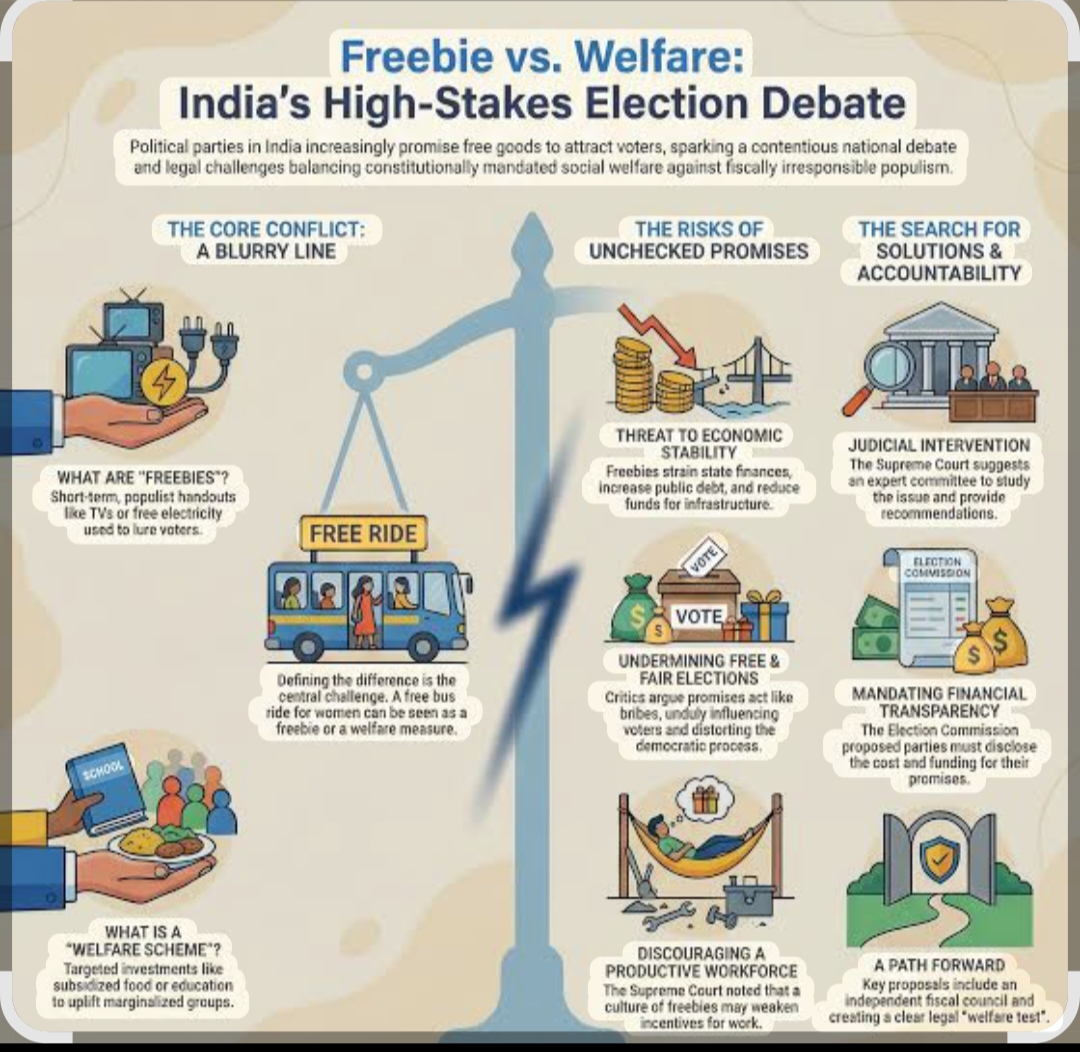
Research Paper: The Politicization of Welfare Schemes: Implications for Governance, Public Finance, and Democratic Outcomes
Abstract
Welfare schemes are fundamentally designed to provide social safety nets, alleviate poverty, and promote equitable socioeconomic growth. However, in contemporary democratic polities, these socio-economic interventions are increasingly subjected to strategic politicization. This paper examines the multi-dimensional facets of the politicization of welfare schemes, transitioning from a framework of structural developmentalism to electoral populism (often referred to as 'freebie' politics or competitive populism). Utilizing a political economy framework, the paper analyzes the impact of this phenomenon on fiscal health, voter behavior, and policy sustainability, with a special focus on emerging democracies like India. The study concludes that while politicization increases the short-term visibility and delivery of welfare, it poses structural risks to long-term economic development and civic accountability by converting state-backed rights into political patronage.
Keywords:Welfare Schemes, Politicization, Competitive Populism, Fiscal Deficit, Electoral Incentives, Clientelism.
1. Introduction
The concept of a welfare state dictates that government interventions should maximize social welfare and protect citizens from structural economic vulnerabilities. Over the last few decades, welfare spending globally has transitioned from residual charity to rights-based entitlement frameworks.
However, in competitive democracies, the dividing line between genuine state-sponsored welfare and targeted political marketing has blurred. Political parties increasingly utilize welfare distribution as a primary mechanism for voter mobilization, rebranding state programs with party symbols, leaders' names, or regional political identity.
This paper seeks to address a fundamental question: **How does the structural politicization of public welfare reshape the democratic relationship between the state and the citizen?** It explores the economic trade-offs, behavioral changes in the electorate, and the policy governance challenges stemming from this transition.
2. Theoretical Framework: The Political Economy of Welfare
To understand this phenomenon, economists and political scientists often rely on two primary theoretical models:
Clientelism and Patronage: Traditional welfare models assume universal delivery based on objective eligibility criteria. Politicization shifts this toward clientelism—a transaction where welfare goods are delivered in exchange for political support (votes).
The Median Voter Theorem & Populism: Political parties design their welfare manifestos to appeal directly to the "median voter." In developing countries with high income inequality, the median voter responds strongly to immediate, tangible cash or material transfers rather than long-term asset creation (e.g., free electricity versus infrastructure investment).
3. Mechanisms of Politicization
The politicization of social security and development schemes manifests through distinct strategic behaviors executed by ruling regimes and opposition coalitions alike:
A. Credit Claiming and Personalization
Instead of presenting welfare as a institutional obligation of the state, programs are deeply personalized. Schemes are frequently named after specific political figures, or accompanied by large-scale public relations campaigns featuring the photograph of the head of government.
B. "Freebies" vs. Core Welfare (Competitive Populism)
There is an escalating policy shift from productive welfare (investments in public education, healthcare, and skill development) consumption-driven populist transfers (free gadgets, fuel subsidies, or unconditional cash transfers right before elections).
C. Temporal Strategic Alignments
Empirical data shows an "electoral budget cycle" where the rollout, budgetary allocation, and cash disbursement of welfare schemes spike significantly in the 6 to 12 months leading up to a general or provincial election.
4. Impact Assessment and Implications
1. Fiscal Implications and Macroeconomic Strain
The most critical fallout of over-politicized welfare is the degradation of public finance.
CapEx Crowding Out: When a disproportionate share of state revenue is locked into committed populist subsidies, Capital Expenditure (CapEx) on infrastructure, irrigation, and industrial corridors drops.
Debt Sustainability: Governments often finance populist schemes through market borrowings, pushing the debt-to-GDP ratio beyond sustainable thresholds, risking long-term inflationary pressures.
2. Transformation of Voter Psychology (The "Labharthee" Phenomenon)
Politicization creates a distinct class of socio-economic beneficiaries—often termed as the Labharthee (beneficiary) vote bank.
Positive Outcome: It ensures immediate, last-mile delivery and reduces administrative leakages due to high political stakes.
Negative Outcome: It replaces performance-based accountability (asking a government about job creation or economic growth) with identity-based or gratitude-based voting, weakening the core democratic feedback loop.
3. Policy Instability and Discontinuity
When political regimes change, highly politicized schemes are often abruptly halted, renamed, or restructured by incoming governments to wipe out the previous administration's political legacy. This institutional instability harms the ultimate beneficiaries who rely on those safety nets.
5. Case Study Focus: The Indian Matrix
The Indian democratic landscape offers a profound example of this phenomenon. The transition from Rights-based welfare (e.g., MGNREGA, Right to Education) in the 2000s to New Welfareism (direct cash transfers, subsidized housing, and digital public infrastructure like PM-Kisan and Jan Dhan accounts) highlights how welfare has become a central pillar of national electoral strategy.
While digitization has effectively bypassed local bureaucratic corruption, the political communication surrounding these schemes ensures that the beneficiary identifies the relief not with the institutional state, but directly with the central or regional political leadership.
6. Policy Recommendations and Corrective Measures
To prevent the weaponization of public welfare for purely short-term electoral gains, structural reforms are required:
Independent Fiscal Watchdogs: Establishing independent fiscal councils to audit election manifestos and assess the long-term impact of proposed welfare schemes on state exchequers.
De-linking Branding from Political Identities: Standardizing the nomenclature of welfare schemes so they are tied to institutional departments rather than individuals or party symbols.
Focus on Asset Creation: Codifying a legal distinction between emergency cash/material relief (welfare) and regressive, non-essential consumption subsidies (freebies).
7. Conclusion
The politicization of welfare schemes is a double-edged sword. On one hand, it creates political urgency, forcing administrative machinery to optimize the delivery of basic goods to marginalized populations. On the other hand, when competitive populism overrides fiscal prudence, it weakens the institutional framework of the state. For democracy to mature, welfare must be viewed not as a political transactional tool or a benevolent gift from a political actor, but as a sustainable mechanism of economic empowerment and a fundamental citizenship right.
References
1. Bardhan, P. (2016). The Political Economy of Development in India Oxford University Press.
2. Keefer, P., & Khemani, S. (2005). Democracy, Public Expenditures, and the Poor." The World Bank Research Observer.
3. Subramanian, A. (2021). "The New Welfareism of India's Ruling Party." Journal of Economic Perspectives.
4. Breuning, M. (2007). Innovative Policy Making and Electorate Behavior. Palgrave Macmillan.
Politicization of Welfare Scheme : Implications for Governanc, Public Finance And Democratic Outcome
📅 22 May 2026 | 🏫 Political Science | 👁️ 207 Views

Dr Pratibha Singh
Political Science
Political Science
🎓 Admissions Open 2026
UG • PG • Diploma • Professional Courses
Limited seats available – Apply now