
Abstract
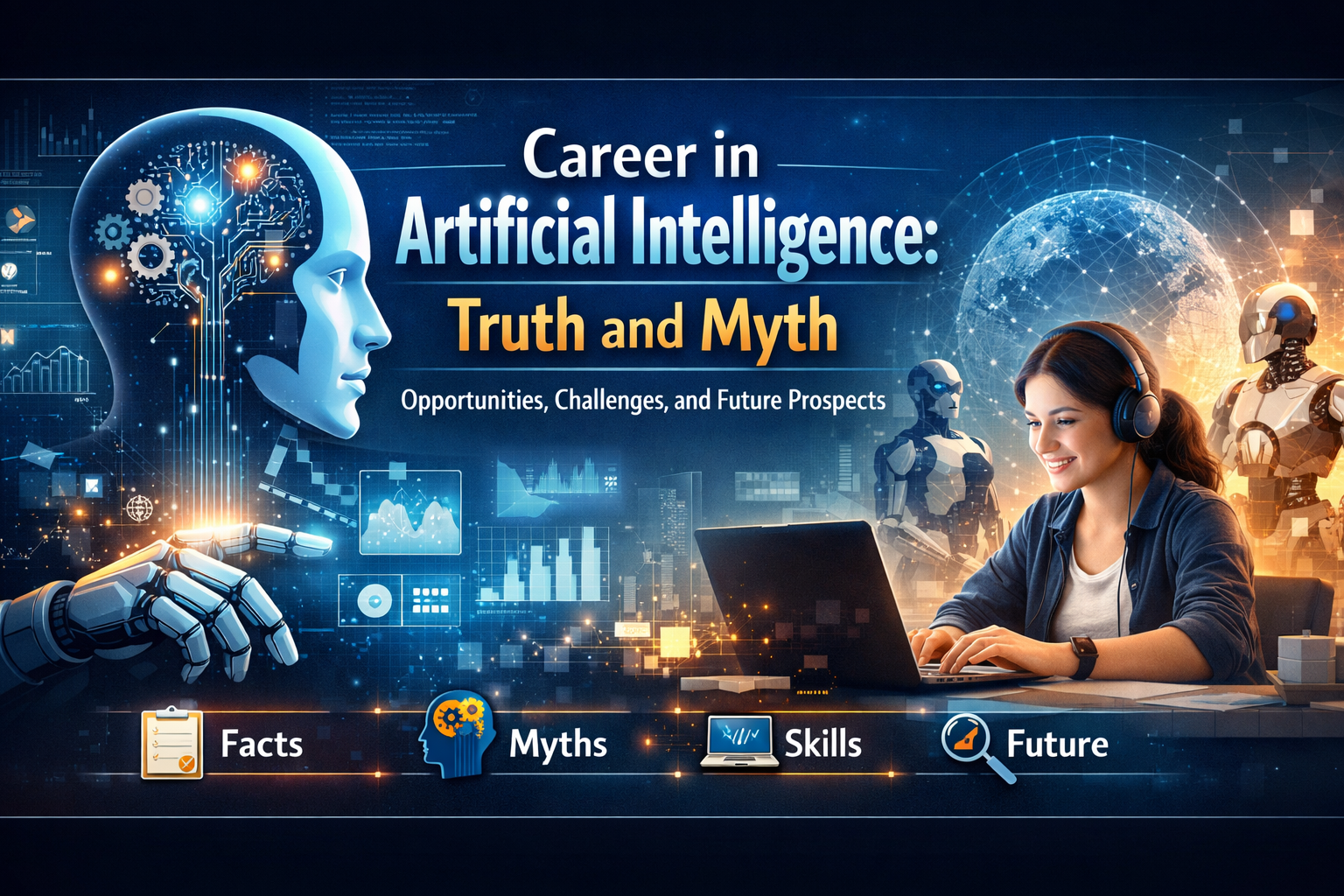
Artificial Intelligence (AI) has become one of the most influential technologies of the 21st century. Many students and professionals consider AI as a promising career path because of its high demand and attractive salaries. However, there are several misconceptions about AI careers. This research thesis examines the reality and myths surrounding careers in Artificial Intelligence, including required skills, career opportunities, challenges, and future prospects. The study aims to provide a clear understanding for students, educators, and professionals who wish to pursue careers in AI.
1. Introduction
Artificial Intelligence refers to the ability of machines to perform tasks that normally require human intelligence, such as learning, reasoning, problem-solving, and decision-making. AI technologies are widely used in industries such as healthcare, finance, education, transportation, and e-commerce.
In recent years, AI has created new career opportunities for computer science graduates and professionals. However, many myths and misconceptions exist about AI careers. Some people believe that AI will replace all jobs, while others think only highly specialized researchers can work in AI. This research aims to analyze the truth and myths related to careers in Artificial Intelligence.
2. Objectives of the Study
The objectives of this research are:
a.To analyze the career opportunities in Artificial Intelligence.
b.To identify common myths related to AI careers.
c.To examine the real skills required to build a career in AI.
d.To study the future scope of Artificial Intelligence.
e.To provide guidance for students interested in AI careers.
3. Research Methodology
This research is based on secondary data sources including:
*Academic journals
*Research papers
*Industry reports
*Online educational resources
*Technology company publications
The information collected from these sources was analyzed to understand the current trends and realities of AI careers.
4. Overview of Artificial Intelligence
Artificial Intelligence is a branch of computer science that focuses on building intelligent systems capable of performing human-like tasks. AI includes several subfields such as:
4.1 Machine Learning
Machine learning allows computers to learn from data and improve their performance without being explicitly programmed.
4.2 Deep Learning
Deep learning uses neural networks to analyze large amounts of data and is commonly used in image recognition and speech processing.
4.3 Natural Language Processing (NLP)
NLP enables computers to understand and process human language.
4.4 Computer Vision
Computer vision allows machines to interpret and analyze visual information such as images and videos.
5. Career Opportunities in Artificial Intelligence
Artificial Intelligence offers various career paths, including:
5.1 AI Engineer
AI engineers design and develop AI systems and applications.
5.2 Machine Learning Engineer
Machine learning engineers create algorithms that allow machines to learn from data.
5.3 Data Scientist
Data scientists analyze large datasets to generate insights and predictions.
5.4 Robotics Engineer
Robotics engineers design robots and intelligent automation systems.
5.5 AI Research Scientist
AI researchers develop new algorithms and technologies to advance AI capabilities.
6. Skills Required for AI Careers
To build a career in Artificial Intelligence, the following skills are important:
Technical Skills
#Programming languages (Python, Java, R)
#Machine Learning
#Data Structures and Algorithms
#Statistics and Mathematics
#Data Analysis
Soft Skills
#Problem-solving ability
#Analytical thinking
#Creativity
#Communication skills
#Team collaboration
7. Myths About Careers in Artificial Intelligence
Myth 1: AI Will Replace All Jobs
Many people believe AI will eliminate human jobs completely.
Myth 2: Only Genius People Can Learn AI Some believe AI is only for highly intelligent individuals.
Myth 3: AI Requires a PhD
It is often assumed that only researchers with advanced degrees can work in AI.
Myth 4: AI Is Only for Computer Scientists Some think AI careers are limited to computer science graduates.
8. Truth About AI Careers
Truth 1: AI Will Create New Jobs
AI will automate some tasks but also create new job opportunities.
Truth 2: Anyone Can Learn AI
With proper training and practice, students from different backgrounds can learn AI.
Truth 3: Practical Skills Are More Important
Many companies prefer practical knowledge and project experience over degrees.
Truth 4: AI Is Interdisciplinary
AI involves fields such as mathematics, psychology, engineering, and data science.
9. Challenges in AI Careers
Despite its potential, AI careers also involve challenges:
#Rapidly changing technology
#High competition in the job market
#Need for continuous learning
#Ethical concerns in AI development
#Requirement of strong mathematical background
10. Future Scope of Artificial Intelligence
Artificial Intelligence is expected to grow rapidly in the coming decades. According to industry experts, AI will significantly impact sectors such as:
#Healthcare
#Education
#Finance
#Transportation
#Cybersecurity
#Smart cities
The demand for AI professionals is projected to increase globally.
11. Conclusion
Artificial Intelligence is one of the most promising career fields in the modern technological era. Although many myths exist regarding AI careers, the reality is that AI offers diverse opportunities for individuals with the right skills and dedication. By understanding the truth and preparing with proper education and practical experience, students can build successful careers in Artificial Intelligence.